
Countdown
10+

Dear reader,
In the coming 10+ weeks, I will be introducing one haggadah1 each week. They all belong to a group of Sephardic haggadot produced on the Iberian Peninsula during the Middle Ages. And they all share the same ‘sibling,’ the Sarajevo Haggadah!
The goal is to finish right before Pesah (Passover) that starts on April, 22nd.
The Prato Haggadah
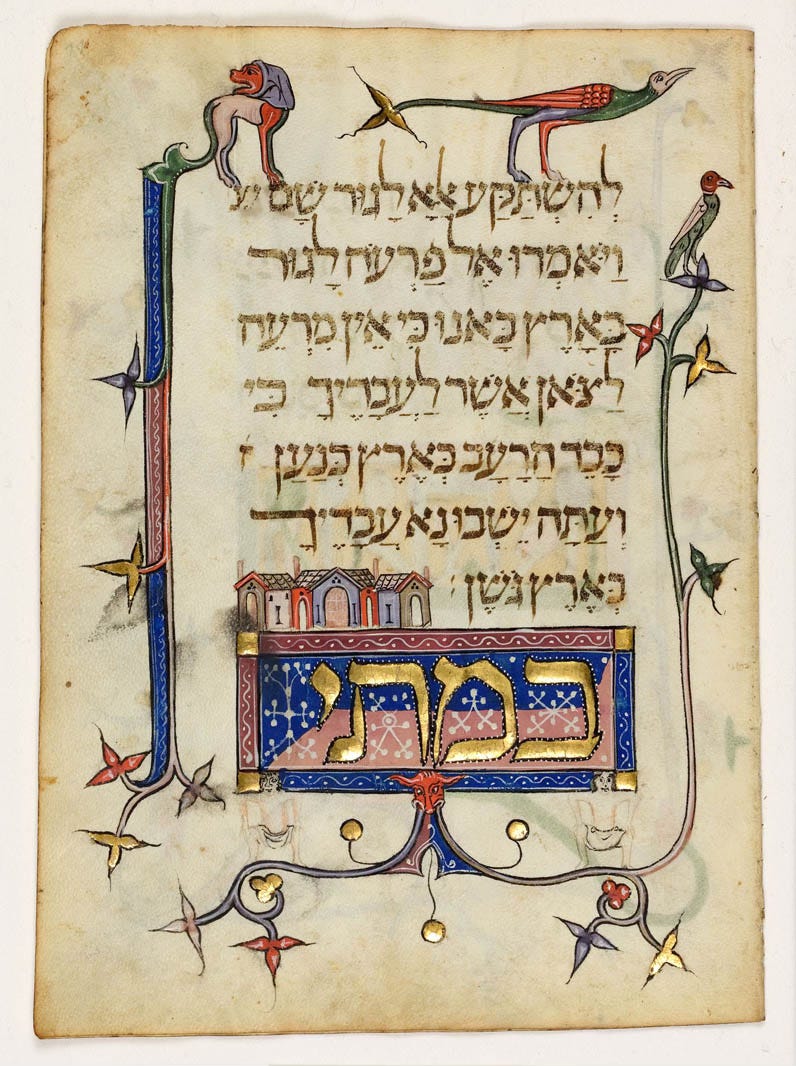


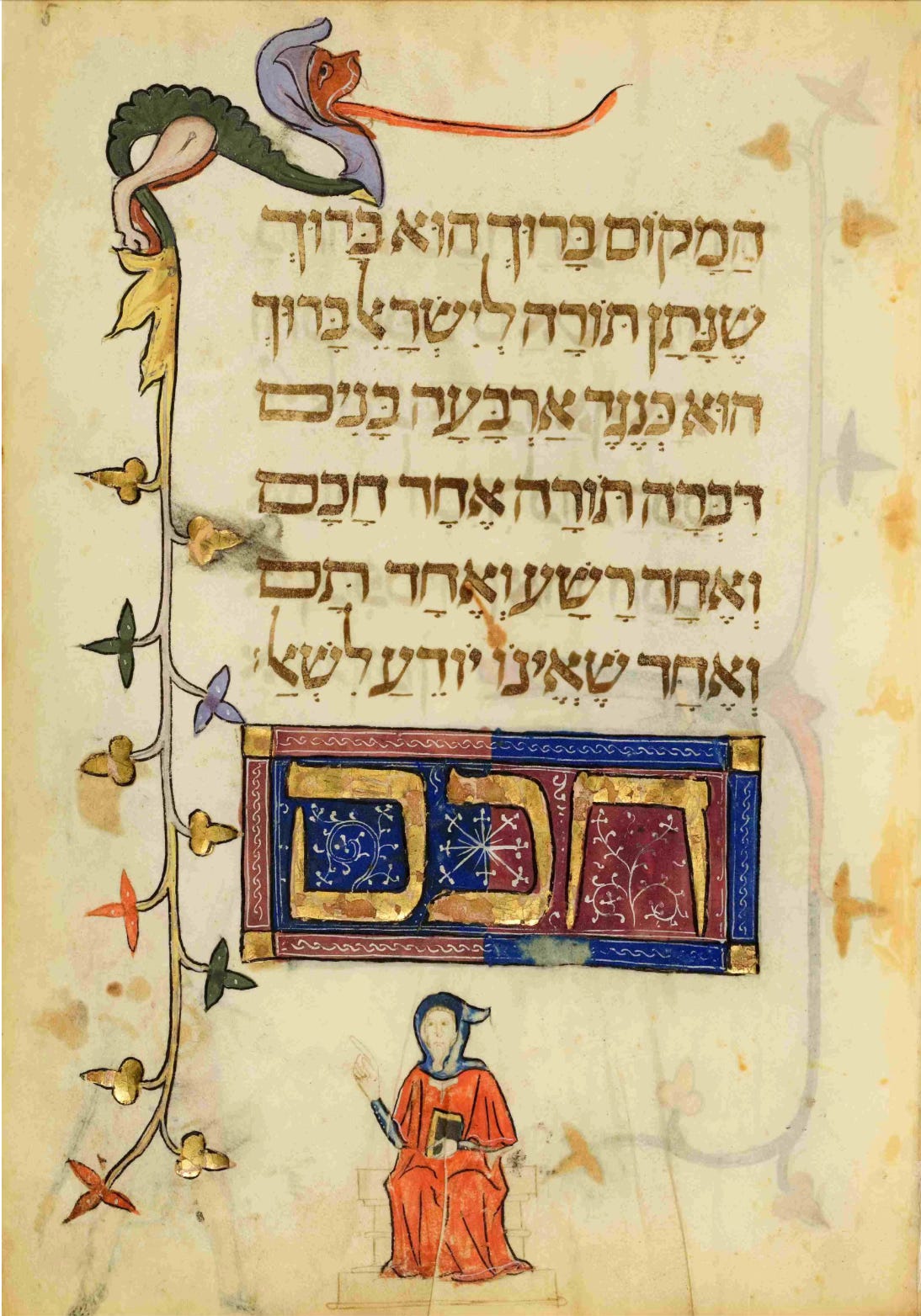
Discussing the Prato Haggadah’s history, Barbara Drake Boehm and Melanie Holcomb, Curators at the Metropolitan Museum of Art2 noted:
The parchment of this Haggadah is pristine; its lettering is impeccable. It is exquisitely painted and gilded—except where it's not. Thirty of its leaves are complete, but a greater number (58) are unfinished. Fifty have text only, and some pages are entirely blank.
There are many blank pages in the history of this manuscript. On the basis of its style and text, scholars agree that it was created in Spain about 1300. What interrupted its completion? Did it stay in Spain until 1492, when the Jewish community was forcibly expelled? Perhaps, for by 1617 it was in Italy, where significant numbers of Jews from the Iberian Peninsula had settled. After 1617, the manuscript's whereabouts are unknown until 1928, by which time it belonged to Dr. Ludwig Pollak. A Czech archaeologist, his most celebrated discovery was the missing right arm of the statue of Laocoön and His Sons, which he gave to the Vatican; his acquisition and safeguarding of this rare Haggadah adds considerable luster to his well-established reputation. Tragically, Dr. Pollak was deported to Auschwitz, where he was killed in 1943. The manuscript, however, was not lost to his family; they gave it to the son of David Prato, chief rabbi of Rome, to whom Pollak had promised the manuscript. The Prato family, in turn, sold it to The Jewish Theological Seminary.3
A brief video introduction of the manuscript:
https://www.metmuseum.org/blogs/in-season/2016/the-prato-haggadah
Digitised manuscript available at: https://digitalcollections.jtsa.edu/islandora/object/jts%3A12249#page/9/mode/thumb